Sensorineural
- Sensorineural hearing loss has bone- and air-conduction thresholds within 10 dB of each other, and thresholds are higher than 25 dB HL. See image below.
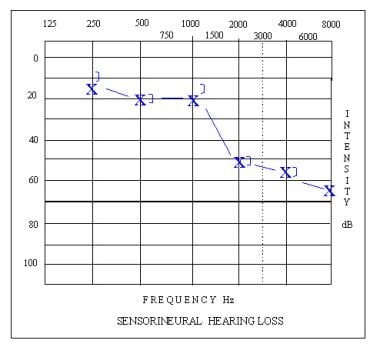 Audiogram depicting a high-frequency sloping sensorineural hearing loss in the left ear.
 - Sensorineural hearing loss is secondary to cochlear abnormalities and/or an abnormality of the auditory nerve or central auditory pathways. Because, in this type of hearing loss, the outer ear and middle ear do not reduce the signal intensity of the air-conducted signal, both air- and bone-conducted signals are effective in stimulating the cochlea. Pure-tone air- and bone-conduction thresholds are within 10 dB.
- Examples included presbycusis, noise-induced hearing loss, Ménière disease, and retrocochlear lesions such as vestibular schwannoma.

No comments:
Post a Comment